- Blue Lion Systems, MSP and IT Consultancy in Nottingham
- [email protected]

Malwarebytes Privacy World
Taken from https://blog.malwarebytes.com/category/security-world/privacy-security-world/feed/
25th July 2017

We’re hearing it a lot lately: encryption is an insurmountable roadblock between law enforcement and keeping us safe. They can’t gather intelligence on terrorists because they use encryption. They can’t convict criminals because they won’t hand over encryption keys. They can’t stop bad things from happening because bad guys won’t unlock their phones. Therefore—strictly to keep us safe—the tech industry must provide them with means to weaken, circumvent, or otherwise subvert encryption, all for the public good. No “backdoors”, mind you; they simply want a way for encryption to work for good people, but not bad. This is dangerous nonsense, for a lot of reasons.
1. It’s technically incorrect
Encryption sustains its value by providing an end to end protection of data, as well as what we call “data at rest.” Governments have asked for both means of observing data in transit, as well as retrieving data at rest on devices of interest. They also insist that they have no interest in weakening..
6th June 2017
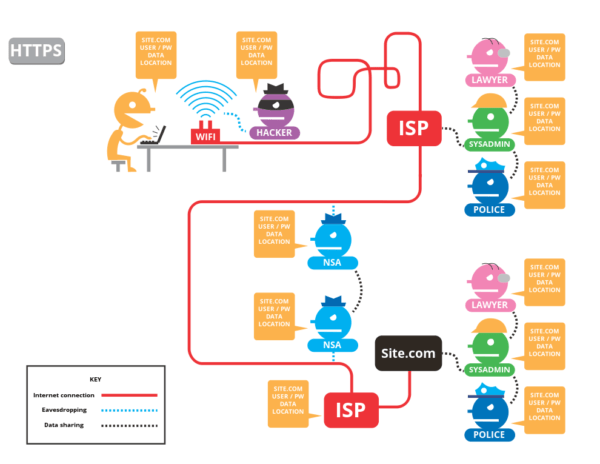
We recently updated our redirections rule in HTTPS-Everywhere, a browser extension that automatically redirects you to the HTTPS version of the website you are trying to visit. Now is a good time for us to give a short overview of how important HTTPS is. We’ll also talk about a few major HTTPS-related events that happened lately.
When we browse the web, several third-parties are able to snoop on the connection between the user and the website, including the user’s ISP, law enforcement, the website’s ISP, and other people in between.
Who can snoop on your connection without HTTPS, and what can they see? (by The TorProject)
These intermediaries are able to obtain and modify on the fly most of the information sent through the connection: the website reached, the web page name and content, the potential username and password, the user’s IP address, and more. It obviously poses a lot of problems, which is why HTTPS is now mandatory for more and more websites (public sector, banks, etc.)...
4th April 2017


In late March, Congress approved a bill lifting restrictions imposed on ISPs last year concerning what they could do with information such as customer browsing habits, app usage history, location data, and Social Security numbers. They additionally absolved ISPs of the need to strengthen their existing customer data holdings against hackers and thieves. For more on the particulars of the bill, you can see reports on the Washington Post and Ars Technica. Given that the repealed restrictions hadn’t yet come into effect, the immediate impact of the new bill is somewhat unclear. But given what typically happens with massive stores of aggregated, location-specific customer data, the prognosis is not good.
So what’s the worst that can happen? Let’s run through a few probable outcomes:
Ad retargeting
We all might be familiar with this; when we buy a product online and then see ads for it relentlessly for a couple weeks thereafter. But with increased granularity of metadata, ad retargeting ..